


FUE vs FUT hair transplant: answer 4 questions and you'll know
Most comparisons just define the two techniques and leave you no wiser. This one gives you the decision framework surgeons actually use — four questions about your scar tolerance, hair length, donor laxity and coverage needed. Answer them and your technique picks itself.
FUE
No linear scar, no stitches, faster recovery, and you can shave your head. More time-intensive per graft.
FUT
Higher graft yield in one sitting and efficient for large areas. Leaves one fine line, needs longer hair.
What is the difference between FUE and FUT hair transplant?
The difference is how donor hair is harvested, and the scar that results. In FUE (Follicular Unit Extraction), follicular units are removed individually with a punch under a millimetre wide, leaving scattered dot marks that stay invisible even on a shaved head. In FUT (Follicular Unit Transplantation), a thin strip of scalp is removed and dissected into grafts, leaving one fine linear scar hidden under surrounding hair.
Everything else follows from that. FUE gives no linear scar, no stitches and a faster recovery, with the freedom to wear your hair very short. FUT can deliver a higher graft count in a single session and suits large coverage needs, but requires sutures, a longer donor recovery, and hair long enough to cover the line.
For most patients today FUE is the default. FUT remains a legitimate option at the highest coverage requirements. Which fits you depends on four factors that can only be measured in person — and at Alloroots that assessment is free.
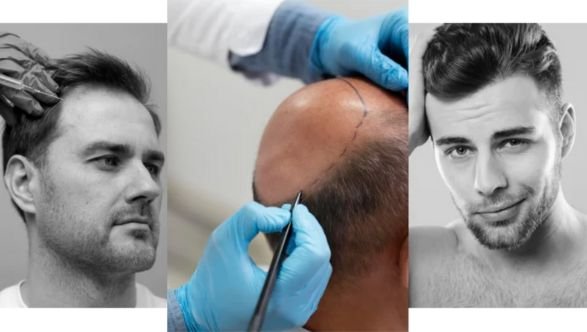
Four questions that decide FUE or FUT
Surgeons don't pick a technique by preference — they pick it by matching these four variables to your scalp and your life. Work through them honestly and the answer usually becomes obvious.
How short do you wear your hair?
This is the highest-weight question. A strip line is invisible under normal-length hair but can show at a very short clip. FUE dot marks stay hidden even shaved.
How loose is your scalp (donor laxity)?
FUT needs enough scalp looseness to close the strip comfortably. A tight scalp makes closure harder and can widen the resulting line. This is measured by hand at consultation.
How much coverage do you actually need?
Your Norwood stage sets the graft target. Moderate needs are comfortably met by FUE; very large coverage can favour a strip's single-session yield — or be staged across two FUE sittings.
How much downtime can you take?
FUE has no stitches, so the donor settles fast and most people are back to desk work in about a week. FUT adds suture removal at 10–14 days and a period of tightness.
Notice the pattern? Three of the four questions point toward FUE for the average patient — which is exactly why it has become the worldwide default. FUT hasn't disappeared; it has narrowed to the specific cases where its one-session yield genuinely wins. If you'd like your four answers measured properly, book a free assessment.
FUE vs FUT: the full comparison
Highlighted cells show which technique holds the advantage on each factor. Scroll sideways on mobile.
| FUE | FUT | |
|---|---|---|
| Harvesting method | Units extracted individually by micro-punch | Strip of scalp removed, then dissected |
| Scar type | Scattered dots, invisible when healed | One fine linear scar under hair |
| Can you shave your head? | Yes | Not to a very short clip |
| Stitches | None | Yes, removed at 10 to 14 days |
| Return to desk work | About 5 to 7 days | Slightly longer, plus tightness |
| Grafts in one session | High | Often higher for very large cases |
| Scalp laxity needed | Works with tight or loose scalps | Needs good laxity |
| Beard / body hair usable | Yes, extends a limited donor | No, scalp strip only |
| Procedure time per graft | Longer | More efficient at volume |
| Growth timeline | Shed 2 to 6 weeks, final 10 to 12 months | Identical |
| Permanence of result | Permanent | Permanent |
The one-line summary: pick FUE for an invisible donor area and a fast recovery; consider FUT only if you need maximum grafts in a single sitting and will always keep your hair long enough to cover a fine line.
The scar difference, explained honestly
The scar is the real fork in the road, and it deserves a straight explanation rather than the scare stories that circulate online.
FUE leaves dots you will not notice
Because each follicular unit is removed with a punch well under a millimetre wide, FUE leaves tiny circular marks distributed across the donor area. Once healed they are extremely difficult to see, including at a grade 1 buzz. For anyone who wears their hair short now or might in the future, this single property settles the decision. Read more about the technique on our FUE hair transplant page, or about Bio-Enhanced FUE and non-shave long-hair FUE for discreet options.
FUT leaves one line, hidden under hair
A well-executed FUT scar is a thin line sitting low at the back of the head, fully covered by surrounding hair at normal lengths. The honest trade is not about ugliness — it is that FUT sets a floor on how short you can go. If your hair has always been medium or long and always will be, that limit may cost you nothing whatsoever.
Recovery: where the two genuinely differ
Both are single-day procedures under local anaesthesia, and the recipient area heals on the same schedule for each. The difference is in the donor area.
With FUE there is no strip wound and no sutures, so the donor settles quickly and most patients return to desk work within five to seven days. With FUT, sutures or staples come out at around 10 to 14 days and there is commonly a period of mild tightness across the back of the scalp while the closure heals.
After that, the journey is identical for both: transplanted hairs shed between weeks two and six, regrowth starts around month three, and the final result lands at 10 to 12 months. Our week-by-week recovery timeline covers the whole process in detail.
Four FUE vs FUT myths, corrected
A lot of what circulates online about these two techniques is outdated or oversold. Here is what is actually true.
A well-executed strip line is thin and hidden under hair. The real limitation is not appearance but hair length — it restricts how short you can clip the back and sides.
No harvesting method is scarless. FUE leaves many tiny dot scars — they are simply so small and dispersed that they are undetectable in practice, even shaved.
Graft quality depends on handling, not harvesting method. Careful extraction and rapid, gentle implantation deliver excellent survival with either technique.
The surgeon decides your result. Graft survival, hairline design and angle control come from skill and time, which is why the same technique produces very different outcomes at different clinics. See cost vs results.
Does FUE or FUT cost more?
Both are usually priced per graft rather than by technique, so your cost is driven mainly by how many grafts you need — not by which harvesting method is used. At Alloroots the guide rate is roughly Rs 60 to Rs 120 per graft, with 0% EMI available so the amount can be spread across monthly instalments. The exact figure is confirmed only after a donor assessment.
Be wary of unusually low quotes attached to either technique. A rate far below the market usually means the saving has come from somewhere that matters — often the qualified surgeon's involvement or graft handling. Our guides on why prices vary and the hidden costs of a hair transplant explain what a fair, all-inclusive price should include. For full pricing, see the hair transplant cost guide or our 0% EMI in Bhubaneswar page.
What patients say about FUE and FUT
Independent patient communities are one of the most useful places to research a hair transplant, because people post unfiltered progress updates and honest questions. We take part in the r/HairTransplants community on Reddit, where patients share month-by-month results and ask about technique choice, donor management and recovery.
- Alloroots patient discussion: choosing between FUE and FUT →
- Alloroots case: donor area healing after FUE, month by month →
- Alloroots case: graft count and coverage planning →
You can also see verified outcomes on our own results gallery and patient testimonials, and read Alloroots reviews.
The surgeon matters more than the technique
Whichever method you choose, your result depends on the person holding the instruments. Both techniques demand skill in extraction, graft handling and artistic placement — and both disappoint in inexperienced hands. Graft survival, the share of follicles that actually grow, is a function of careful handling, not of the harvesting method.
At Alloroots, every procedure is performed personally by Dr. Alok Kumar Sahoo, MBBS, MD (Dermatology and Venereology) from AIIMS New Delhi — one of the postgraduate qualifications India's National Medical Commission recognises for hair transplantation. He carries out the extraction, slit-making and implantation himself, across 3,000+ procedures at our Patia clinic in Bhubaneswar.
"The doctor did the extraction, slit-making and implantation himself, and the final look exactly matched the design drawn on my scalp. Aseptic measures were highly maintained - no oozing or crusting."Benugopal Google review · Alloroots Bhubaneswar
Rated 5.0 from 163 Google reviews. Read them on Google →
FUE vs FUT — frequently asked questions
Is FUE better than FUT?
Neither is universally better — they trade different things. FUE leaves no linear scar, heals faster and lets you shave your head, which is why it is the default for most patients. FUT can deliver a higher graft count in one session and suits people who keep their hair long enough to cover a fine line. Three of the four decision factors (hair length, scalp laxity, downtime) usually favour FUE, which is why it dominates today.
Does FUE leave any scar at all?
Yes, but not one you will notice. FUE leaves tiny circular dot scars where each follicular unit was removed, spread across the donor area. Once healed they are effectively undetectable, including at very short hair lengths and on a shaved head. No harvesting method is truly scarless — FUE's marks are simply too small and dispersed to see.
Which has a faster recovery, FUE or FUT?
FUE. With no stitches and no strip wound, the donor area settles quickly and most patients return to desk work within five to seven days. FUT involves sutures removed at around 10 to 14 days plus a period of mild tightness. The transplanted area and the 10 to 12 month growth timeline are the same for both. See our recovery timeline.
Can FUT give more grafts than FUE?
In a single session, often yes — a donor strip provides a large block of tissue to dissect at once, which helps in very extensive cases. However, modern FUE reaches ample graft counts for most patients, and it can draw on beard and body hair to extend a limited donor area, which FUT cannot do. Large FUE cases can also be safely staged across two sittings.
Is FUE or FUT more painful?
Both are performed under local anaesthesia, so there is little discomfort during the procedure. Afterwards, FUT tends to cause more tightness and soreness at the donor site because of the strip closure, while FUE's dot sites are usually less tender. Discomfort with either technique is mild and managed with prescribed medication.
Does my scalp tightness affect which technique I can have?
Yes, significantly. FUT requires enough scalp laxity (looseness) to close the donor strip comfortably; a tight scalp makes closure harder and can lead to a wider line. FUE does not depend on laxity, so it suits both tight and loose scalps. Laxity is assessed by hand during your consultation.
How much do FUE and FUT cost in Bhubaneswar?
Both are usually priced per graft rather than by technique, so cost depends mainly on how many grafts you need. At Alloroots the guide rate is roughly Rs 60 to Rs 120 per graft, with 0% EMI available, and the exact figure is confirmed after a donor assessment. See the full cost guide.
Which technique does Alloroots recommend?
It depends on your case — we do not sell one technique as a default package. For most patients, particularly anyone who wears their hair short, FUE is recommended. FUT is considered where a very high one-session yield is needed and the patient keeps their hair long. Dr. Alok measures your donor density, scalp laxity and coverage needs in person, then recommends what genuinely fits. Book a free assessment.
Get your four answers measured — free
Thirty minutes with an AIIMS-trained surgeon in Patia: donor density, scalp laxity, coverage needed and a technique recommendation that fits your hair and your life. No charge, no pressure.
International Society of Hair Restoration Surgery (ISHRS) — patient guidance on hair transplant techniques and choosing a surgeon. ishrs.org
American Academy of Dermatology (AAD) — independent overview of hair transplant procedures. aad.org
National Medical Commission (India) — qualifications recognised for performing hair transplantation. nmc.org.in
r/HairTransplants — independent patient community discussion. reddit.com/r/HairTransplants
This article is general information, not medical advice. Your suitable technique is determined by a qualified doctor after an in-person assessment.


