


Hair patch vs hair transplant: are you renting hair, or owning it?
That single question settles most of this debate. A hair patch is a recurring rental you keep paying for, forever, and never own. A hair transplant is a one-time purchase of your own permanent hair. Below is the honest 10-year cost math, the daily friction nobody warns you about, and how to switch if you already wear a patch.
Hair patch
Instant result, low upfront price. But it needs re-taping, servicing and replacement forever, and it never becomes your hair. Stop paying and you are back to bald.
Hair transplant
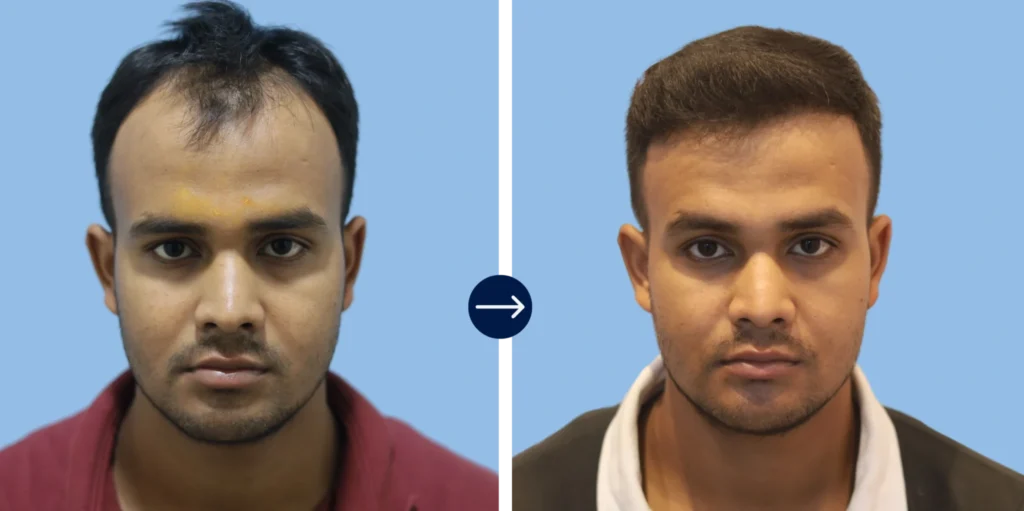
Takes 10 to 12 months to grow in and costs more upfront. Then it is done: permanent, maintenance-free, and genuinely your own growing hair.
Hair patch or hair transplant: which is better?
For most people with a healthy donor area, a hair transplant is the better long-term choice. A hair patch (also called a hair system, hair wig or non-surgical hair replacement) is a synthetic or human-hair unit attached to your scalp with clips, tape or adhesive. It delivers an instant result at a low upfront price, but it is temporary: it needs regular servicing and replacement, and it never becomes your own hair.
A hair transplant relocates your own DHT-resistant follicles into thinning areas. It takes 10 to 12 months to fully grow in and costs more upfront, but it is permanent, maintenance-free and undetectable, because it is simply your own hair growing where it should.
Over several years, patch upkeep usually costs more in total than a single transplant, while leaving you owning nothing. A patch makes sense mainly if you need hair instantly, are not a surgical candidate, or want a temporary trial.
What each option actually costs you over 10 years
A hair patch looks cheaper because you only ever see the next payment. Lay both options across a decade and the shape of the decision changes completely.
The EMI comparison worth making: a patch's monthly upkeep and a transplant's 0% EMI instalment can look similar month to month. The difference is that the transplant payments end, and you keep the hair. The patch payments never end, and you keep nothing. See our hair transplant cost guide for exact figures.
The daily friction nobody mentions
Cost is only half the decision. The other half is what each option asks of you every single day.
Swimming and the beach
Sport, gym and sweat
Wind and rain
Close contact and intimacy
Scalp health over time
Your calendar
Hair patch vs hair transplant: the full comparison
Highlighted cells show which option holds the advantage. Scroll sideways on mobile.
| Hair patch | Hair transplant | |
|---|---|---|
| Speed of result | Instant, same day | Grows in over 10 to 12 months |
| Permanence | Temporary, replaced regularly | Permanent, for life |
| Is it your own hair? | No | Yes |
| Maintenance | High: re-taping, servicing, replacement | None beyond normal washing |
| Upfront cost | Low | Higher, one time (0% EMI available) |
| Long-term cost | Recurring forever | One time, then nothing |
| Natural appearance | Can look good, but detectable up close | Completely natural |
| Swim, sweat, sport | Needs care, can lift | No restrictions once healed |
| Scalp health | Adhesive irritation and traction risk | Healthy once healed |
| Surgery required | No | Yes, one day under local anaesthesia |
| What you own at the end | Nothing | Your own permanent hair |
When a hair patch genuinely makes more sense
We perform hair transplants, so it would be easy to dismiss patches entirely. That would not be honest. A hair patch is a reasonable choice in specific situations:
- You need hair immediately for a wedding, a shoot or an event that will not wait 10 months.
- You are not a surgical candidate - for example if your donor area is too depleted to supply enough grafts, or a medical condition rules out surgery.
- Your hair loss is very advanced and still progressing, so a transplant alone could not yet give the coverage you want.
- You want a temporary trial of how fuller hair looks and feels before committing to anything permanent.
A good clinic will tell you plainly if you fall into one of these groups. Sometimes the right sequence is to first stabilise active loss with Minoxidil, Finasteride, PRP or GFC, then plan surgery when the picture is stable. Our guide on whether you actually need a hair transplant walks through that decision without any sales pressure.
How to switch from a hair patch to a transplant
Many of our patients arrive having worn a system for years and decided they want to stop renting. The transition is straightforward, and you can keep wearing your patch through most of it.
Get your donor assessed
The only question that matters first is whether your donor area can supply the grafts you need. This takes minutes, and at Alloroots it is free. Long-term adhesive use is also checked for scalp health.
Stabilise, then plan
If pattern loss is still active underneath, medication or PRP may be advised first so your result is built on a stable base. Your graft count and hairline are then designed with you.
Transition and grow out
After the procedure and initial healing, your own hair grows in over 10 to 12 months. Your surgeon advises when it is safe to stop using the system entirely.
One important note for long-term patch wearers: years of adhesive and tension can irritate the scalp and, in some cases, contribute to traction-related loss around the attachment edges. That does not rule out a transplant, but it does make a proper dermatological assessment important before planning. Dr. Alok is an MD Dermatologist, so scalp health is assessed as part of the same consultation.
What Alloroots patients have shared publicly
Independent patient communities are among the most useful places to research this decision, because people post unfiltered progress updates rather than marketing. Below are Alloroots cases shared by patients on the r/HairTransplants community on Reddit.
- Hair transplant at age 24 - Alloroots Bhubaneswar → A younger patient's case at our Bhubaneswar clinic, shared on Reddit. Useful if you are weighing a permanent solution early rather than committing to years of a hair system.
- "Took the plunge" - M27, Alloroots India, 2,640 grafts → A 27-year-old patient's 2,640-graft case. A helpful reference point for what a mid-size graft count involves and what the decision to commit actually looks like.
You can also browse verified outcomes on our results gallery, patient testimonials and Alloroots reviews.
Owning your hair is worth doing properly
If you are going to stop renting and buy, the quality of what you buy matters enormously. A transplant is permanent in both directions: a good one lasts a lifetime, and a poor one is expensive and difficult to correct. Graft survival and hairline design come from surgical skill, not from marketing.
At Alloroots, every procedure is performed personally by Dr. Alok Kumar Sahoo, MBBS, MD (Dermatology and Venereology) from AIIMS New Delhi - one of the postgraduate qualifications India's National Medical Commission recognises for hair transplantation. He carries out extraction, slit-making and implantation himself, across 3,000+ procedures at our Patia clinic in Bhubaneswar.
"The doctor did the extraction, slit-making and implantation himself, and the final look exactly matched the design drawn on my scalp. Aseptic measures were highly maintained - no oozing or crusting."Benugopal Google review · Alloroots Bhubaneswar
Rated 5.0 from 163 Google reviews. Read them on Google →
Hair patch vs hair transplant — frequently asked questions
Is a hair patch better than a hair transplant?
For most people with a healthy donor area, a hair transplant is better long term because it is permanent, maintenance-free and uses your own hair. A hair patch is better only in specific situations: when you need an instant result, are not a surgical candidate, or want a temporary solution. A patch is cheaper upfront but costs more over time and never becomes your own hair.
Is a hair patch cheaper than a hair transplant?
Only upfront. A patch has a low initial price but requires ongoing servicing, re-attachment and replacement for as long as you wear it, so across several years the cumulative cost usually exceeds a one-time transplant. A transplant is a single cost, with 0% EMI available, after which there is no further spending.
Does a hair patch damage your existing hair or scalp?
It can over time. Adhesives and clips applied repeatedly to the same area may irritate the scalp, and constant tension (traction) can contribute to further hair loss around the attachment edges. This is why long-term patch wearers should have a dermatological scalp assessment before planning a transplant.
Can I switch from a hair patch to a hair transplant?
Yes, and many patients do exactly that. The first step is a donor assessment to confirm you have enough grafts available, along with a check of scalp health after long-term adhesive use. If pattern loss is still active, it may be stabilised with medication or PRP first. You can usually keep wearing your system through much of the transition.
Does a hair transplant look more natural than a hair patch?
Yes. A transplant uses your own growing hair, so there is no base, no edge and nothing to detect - it looks, feels and behaves naturally because it is natural. Even a well-made patch can be noticeable up close, in wind, or at the hairline, which is a common reason wearers eventually switch.
How long does each option last?
A hair transplant is permanent: the relocated follicles are genetically resistant to balding and continue to grow for life. A hair patch is temporary and must be serviced regularly and replaced every few months, indefinitely, for as long as you want the look.
Who is not a good candidate for a hair transplant?
People with a severely depleted donor area, very advanced and still-progressing hair loss, or certain medical conditions may not be immediate candidates. In those cases a specialist may recommend stabilising the loss first or discuss alternatives honestly. A free assessment is the only reliable way to know.
How much does a hair transplant cost in Bhubaneswar?
Cost depends mainly on how many grafts you need. At Alloroots the guide rate is roughly Rs 60 to Rs 120 per graft, confirmed after a free donor assessment, with 0% EMI available to spread it across monthly instalments. See the full hair transplant cost guide and how many grafts you need.
Stop renting. Find out if you can own it.
A free 30-minute assessment with an AIIMS-trained dermatologist in Patia tells you whether your donor area can support a permanent result - and exactly what it would cost. No charge, no pressure.
American Academy of Dermatology (AAD) - independent overview of hair transplant procedures and hair loss treatment. aad.org
International Society of Hair Restoration Surgery (ISHRS) - patient guidance on choosing a hair restoration provider. ishrs.org
National Medical Commission (India) - qualifications recognised for performing hair transplantation. nmc.org.in
r/HairTransplants - independent patient community, including Alloroots patient cases linked above. reddit.com/r/HairTransplants
This article is general information, not medical advice. Suitability for a hair transplant is determined by a qualified doctor after an in-person assessment.


